Journal Entry

The Alchemist’s Amen: A Declaration of Repentance

There is a specific kind of exhaustion that comes from carrying a past you’ve already outlived. Lately, I’ve been wrestling with the ghosts of my own choices, feeling the weight of things I thought were buried. This post is my exhaling. It is a declaration of where I’ve been, what I’ve done, and the mercy I am finally choosing to accept.”

If you are carrying a weight that was never meant for your shoulders, I invite you to leave a piece of it here. What is one thing you are ready to forgive yourself for today? Let’s walk toward the light together.

For days, my mind has been a battlefield where peace went to die. I have been breathing the stale air of a “past long gone,” dragging old ghosts into the present until my soul became heavy with the haunting. I felt it in my marrow and in the “second brain” of my stomach—a rising acid of remorse, a conflict of the ego that no medicine could soothe.

I realized that to swallow this bitterness any longer would be to drown.

Today, I choose the only way out: The way of the Alchemist. I am turning my culpability into a present accountability. I am not merely apologizing for my struggle; I am honoring it by allowing it to become a testimony.

The Confession

I walked a path of shadows and ill repute,

Weaving webs of manipulation for a life of gilded ease.

I cost men their kingdoms to furnish my own,

Trading integrity for a view few ever see.

I asked for love, and when the Great Provider gave a seed,

I let fear bloom where a child should have grown.

I cast away the miracle to keep the ghost of my freedom,

Choosing the cold silence of “no” over the warmth of “yes.”

I have been the architect of my own envy,

Comparing my reflection to a world of curated lies.

I have been lazy in my promises and a shortcut-taker in my craft,

Slandering the innocent and dismissing the weary with a judge’s gavel.

I have lacked the very character I claimed to possess,

Wounding the seen and the unseen with the sharp edge of my ego.

The Surrender

But the acid has reached the brim, and I am finished with the burning.

Heavenly Father, I stand before You stripped of my pretenses.

I confess the stains, the shortcuts, and the intentional hurts.

I ask for the blood of Jesus to act as a holy solvent—

To wash the “ill repute” until only the “reputation of Grace” remains.

Forgive me for the pain I caused that I cannot see.

Forgive me for the years I spent coveting what was never mine.

Take the lordship of every broken room in my heart.

The New Spirit

I exchange my “second ego” for Your first-rate Peace.

I thank You for the courage to look at my reflection without flinching,

And for the mercy that refuses to run dry, even when I am parched.

Create in me a clean heart, O God; and renew a right spirit within me.

The struggle is honored. The sin is covered. The testimony begins.

I’ve learned that my body was never meant to be a warehouse for my regrets. It was meant to be a temple for my peace. How are you tending to your temple today?

Journal Entry

The Long Goodbye: Navigating Anticipatory Grief and Chronic Illness

When we think of grief, we often think of it as a destination—a place we arrive at only after a loss has occurred. But for those living through the chronic or terminal illness of a loved one, grief doesn’t wait for a final breath. It settles in early, making itself at home in the quiet corners of the caregiver’s heart.

This experience is known as anticipatory grief, and it is one of the most complex layers of the human experience. At The Soft Armor, we believe in acknowledging these heavy truths so we can better equip ourselves for the journey.

Understanding the “Invisible” Loss

Anticipatory grief is unique because it isn’t just about the fear of the future; it’s about the losses happening in the present. It is the trauma of watching someone’s world shrink. You might be grieving:

• The loss of a role: Moving from partner or child to full-time caregiver.

• The loss of shared dreams: Letting go of travel plans or future milestones.

• The loss of personality: Navigating the way illness can change a person’s temperament or cognitive abilities.

The Trauma of the “Wait”

Living in a state of constant high alert—waiting for the next phone call, the next scan, or the next dip in health—creates a specific kind of physiological trauma. Your nervous system stays “on,” prepared for a crisis that hasn’t fully arrived but feels inevitable.

This sustained stress can lead to “caregiver burnout,” but it’s more than just exhaustion; it’s the soul’s reaction to holding onto someone who is slowly slipping away.

Finding Your “Soft Armor”

How do we protect ourselves while remaining open and present for those who need us?

1. Grant Yourself Permission: Understand that feeling grief right now doesn’t mean you’ve given up hope. It means you are processing the reality of the situation.

2. Acknowledge the Secondary Losses: It is okay to be sad about the “small” things—the lost Sunday morning coffee routines or the quiet house. These are the threads of your daily life being pulled away.

3. Create Pockets of Stillness: When the trauma of illness feels loud, find a ritual that grounds you. Whether it’s a heavy blanket, a specific scent, or five minutes of intentional breathing, find the “armor” that makes you feel safe.

4. Seek Community: Grief is isolating, but you are not alone. Sharing your story with those who understand the “long goodbye” can lighten the emotional load.

Moving Through, Not Over

There is no “getting over” the trauma of sickness and loss. There is only moving through it, one heartbeat at a time. By acknowledging the grief we feel before the loss, we honor the depth of our love and the difficulty of the path we are walking.

Be kind to yourself today. You are doing the hardest work there is.

Inspiration

Thirty-Two Years of the Leap

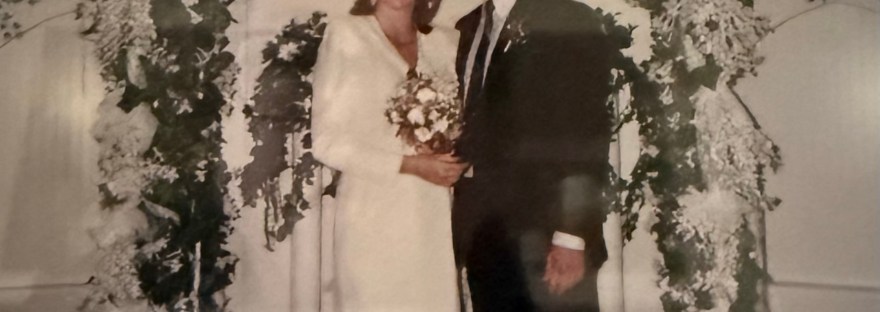
I look at this picture and I can still feel my knees shaking. I remember the weight of the question hanging in the air: would this marriage last for months, for decades, or for a lifetime? Behind my smile, I was a whirlwind of emotion—deeply honored to be Scott’s wife, yet breathless from the whirlwind of it all. “Do you want to get married today?” he had asked just hours earlier.

An elopement at the Rockwall wedding cottage, a quick trip to Dillard’s Travel, and suddenly we were on our way to San Antonio. We didn’t have much then, just a weekend at SeaWorld and each other. In this photo, I was four months pregnant and, if I’m honest, I was scared to death. I was terrified that I wasn’t ready for motherhood—that I wasn’t up to the monumental challenge of raising a child.

And yet, I felt safe.

Wrapped in his arms, I found a sanctuary. Scott brought with him a history of steadiness that I leaned on completely. I trusted that he could navigate us through the unknown; I believed he was capable enough to help rewrite the parts of me that felt broken. I took the leap because of the man he was—a product of a home filled with honor and intentional love. I saw his mother, a woman born to parent, and his father, a jovial and present man whose every move was rooted in kindness. I knew Scott would bring that legacy into our home.

For thirty-two years, he has done exactly that.

Our journey hasn’t been perfect. Anyone who truly knows us can attest that there were seasons of selfishness, moments where we prioritized our own interests over the “us.” But whenever level heads prevailed, the love that sparked that first impulsive “yes” brought us back to center. It kept us learning, growing, and moving in the same direction.

Today, he is my absolute best friend. Our lives are a tapestry of shared ideas, a common moral compass, and a deep, aligned faith. Whether it’s our hobbies or our values, we simply enjoy life more when we are doing it together. Looking back at that shaking girl in the photograph, I wish I could tell her: Don’t worry. You chose well.

Uncategorized

The Decade Vigil

“They tell you that as you get older, the circle of life begins to close. You expect to say a slow, quiet goodbye to the generation before you. But no one warns you about the stolen decade. No one tells you what it feels like to trade ten years of your own life for the fluorescent lights of a hospital corridor and the rhythmic, hollow beep of a heart monitor.

I am a person of deep empathy. I believe with my whole heart in the dignity of the dying and the comfort of the sick. But I am also just a human being. Why does it feel like the universe has decided my shoulders are the only ones strong enough to carry the grief of an entire lineage? I am not just a witness to death; I have become the custodian of it.

I have watched them leave, one by one. I have seen the light go out in eyes I’ve known since childhood, often in ways so tragic and horrific they leave scars no one else can see. And the cruelty of it is that I don’t even have the luxury of sitting with my own mourning. I am forced to grieve the dead while I am still physically holding the hands of those who are fading.

I find myself looking at the horizon, wondering: When is it my turn to breathe? When do I get to wake up and belong only to myself, rather than being tethered to a diagnosis or a palliative care plan?

I am not angry—I am simply hollow. I hate the suffering. I hate that I have become an expert in a language I never wanted to speak. I am unregulated and overwhelmed today because I am tired of being the only bridge between the living and the lost. I just want to be free.”

What I’m experiencing isn’t just “stress”; it is compassion fatigue and anticipatory grief rolled into one. I am allowed to feel “unregulated.” When I spend all my time regulating the comfort of others, my own soul eventually runs out of steady ground. 💔