Human Interest

When Others Judge – Holding it Together

These past weeks have been a DOOZY for me. While I used to be a bad ass during stressful situations, I have come to learn with experience that loss, real loss, devastating – change – your – life -loss can happen in a moment. Sometimes I think I am one more change away from losing my mind. The older I get the more the fear of loss is real. There’s been a great deal of trauma involved, and that lends itself to more anxiety. Faith. I must have it. God’s got this I tell myself. Naturally, I must learn to believe that.

People often get mad when they’re afraid because anger can be a defense mechanism to cope with the uncomfortable feelings of fear and a sense of vulnerability. If trauma has taught them they cannot trust an unknown outcome, this can be very scary for the people on the other side of that fear. Both fear and anger trigger the “fight-or-flight” response, releasing stress hormones and preparing the body for action. When the nervous system is activated by fear, an individual may unconsciously choose to express this heightened energy as anger, a way to regain a sense of control and protect themselves from a perceived threat.

Anxiety and anger activate the body’s fight-or-flight (stress) response, which triggers the hypothalamic-pituitary-adrenal (HPA) axis to release cortisol, the primary stress hormone. Specifically, the hypothalamus releases corticotropin-releasing hormone (CRH), which signals the pituitary gland to release adrenocorticotropic hormone (ACTH). This, in turn, prompts the adrenal glands to produce and release cortisol into the bloodstream, providing energy to deal with the perceived threat.

I am not sure what the answer is to make sure people around me feel loved. If I lose my shit, something awful has just happened. I am in the thick of cortisol jet streaming throughout my body, and I am one comment away from either losing my mind or walking away because the emotion is too great for me. Horrible but true.

Breathe Beck. Just Breathe.

Human Interest

Unbreakable: What I’ve Learned About Stress, Strength, and Moving Forward

There are moments in life when stress doesn’t just tap you on the shoulder—it knocks you flat. Recently, I found myself in one of those moments. The pressure built up so intensely that my body waved a white flag: shingles, right inside my eyes. The headaches, exhaustion, and relentless fatigue were unlike anything I’d known. For someone who has always prided herself on grit and stamina, it was a humbling wake-up call.

When I was younger, I wore stress like a badge of honor—thriving on the adrenaline, juggling a million things, always pushing for more. But as the years have added up, so has the cost of that constant hustle. This older body? It doesn’t bounce back the way it used to. Every ache, every bit of fatigue, is a reminder that I’m not invincible.

But here’s what’s unshakable: my spirit.  

I am tenacious to the core. Even when my body is tired, my will is fierce. I believe—truly—that the mind can overcome anything life throws our way. I refuse to let a diagnosis, a setback, or a tough season define me. Instead, I choose to show up. I show up with purpose, with intent, and with the determination to do what needs to be done—no matter how hard it feels.

That’s what courage looks like.  

It isn’t always flashy or loud. Sometimes, it’s just putting one foot in front of the other when you’d rather stay in bed. It’s making the call, writing the email, or meeting the client when your energy is running on empty. It’s refusing to let fear or pain dictate your story.

Resilience isn’t about never falling down—it’s about how many times you get back up.  

So even as my cortisol levels wreak havoc and my body begs for rest, I keep moving forward. One deliberate step at a time. Because that’s who I am—unstoppable.

If you’re facing your own season of stress or struggle, know this:  

You are stronger than you think. Your spirit is tougher than any challenge. And even when life tries to slow you down, you have the power to keep going.

Here’s to every one of us who keeps showing up, no matter what.  

We are unbreakable.

Human Interest

Navigating Adversity: How Men and Women Approach Life’s Challenges Differently

Adversity is a universal part of life, but how we respond to it can be shaped by everything from upbringing and cultural norms to biology and social support. Let’s explore how men and women typically approach difficult situations, the underlying psychology, and why community—especially for women—is so crucial for resilience.

A Man’s Perspective: Facing Adversity

When confronted with adversity, men often lean on problem-solving and action-oriented strategies. Psychologists call this a “fight-or-flight” response, rooted in both evolutionary biology and social conditioning. Men may feel compelled to “fix” the problem, seek solutions, or sometimes withdraw to process emotions privately.

Typical Male Responses:
– Problem-Solving: Men often try to identify practical solutions and take direct action. This approach is linked to a sense of control and competence.  

– Emotional Suppression: Research shows men are more likely to suppress emotions or avoid discussing feelings, partly due to social norms around masculinity (Mahalik et al., 2003).

– Independence: Men may resist seeking help, valuing self-reliance and autonomy, sometimes to their own detriment (Addis & Mahalik, 2003).

Why This Happens:  
Societal expectations often reward men for stoicism and self-sufficiency. From a young age, boys are taught to “tough it out,” which can make vulnerability feel risky or unmanly. This doesn’t mean men don’t feel deeply; rather, they’re less likely to express distress outwardly or ask for support.

Strengths and Pitfalls:
While this approach can lead to decisive action and resilience, it may also result in isolation, unaddressed stress, or even health issues if emotions are bottled up for too long (Courtenay, 2000).

A Woman’s Perspective: Facing Adversity

Women, by contrast, are more likely to respond to adversity through connection and emotional expression. This is often described as the “tend-and-befriend” response—a term coined by psychologist Shelley Taylor. Women are more likely to seek social support, talk about their feelings, and build networks of care.

Typical Female Responses:
– Seeking Support: Women are more inclined to reach out to friends, family, or support groups when facing difficulties (Taylor et al., 2000).
– Emotional Expression: Women often process adversity by expressing and sharing their emotions, which can promote healing and perspective.
– Collaboration: Women may approach problems collaboratively, brainstorming solutions with others and valuing consensus.

Why This Happens:  
Biologically, the hormone oxytocin—released in response to stress—promotes social bonding and affiliative behaviors, particularly in women (Taylor et al., 2000). Culturally, girls are often encouraged to talk about their feelings and seek support, reinforcing these patterns into adulthood.

Strengths and Pitfalls: 
This approach can foster resilience, reduce feelings of isolation, and provide practical help. However, women may sometimes prioritize others’ needs above their own or struggle if they lack a supportive network.

The Importance of a “Tribe” for Women

The concept of having a “tribe”—a close-knit circle of friends or supporters—is especially vital for women. Research shows that strong social connections are one of the greatest predictors of resilience and well-being, particularly for women navigating adversity (Umberson & Montez, 2010).

Why a Tribe Matters:
– Emotional Support: Sharing struggles with trusted confidantes can reduce stress, increase feelings of belonging, and buffer against depression.
– Practical Help: Friends can offer advice, resources, or hands-on assistance during tough times.
– Identity and Validation: A tribe affirms a woman’s experiences, helping her feel seen and understood.

Science Backs It Up:
Women with strong social networks have better mental and physical health outcomes, recover more quickly from setbacks, and experience lower rates of anxiety and depression (Taylor et al., 2000; Umberson & Montez, 2010).

In Summary

While everyone’s experience is unique, men often default to action and independence, while women gravitate toward connection and collaboration. Both approaches have strengths and limitations, but for women, having a supportive “tribe” is especially powerful for weathering adversity. Recognizing and honoring these differences can help us build more supportive communities—and remind us that, in challenging times, we all benefit from a little help from our friends.

Sources

– Addis, M. E., & Mahalik, J. R. (2003). Men, masculinity, and the contexts of help seeking. *American Psychologist*, 58(1), 5-14.
– Courtenay, W. H. (2000). Constructions of masculinity and their influence on men’s well-being: a theory of gender and health. *Social Science & Medicine*, 50(10), 1385-1401.
– Mahalik, J. R., et al. (2003). Masculinity and men’s health behaviors: The moderating role of gender role conflict. *Psychology of Men & Masculinity*, 4(1), 74.
– Taylor, S. E., et al. (2000). Biobehavioral responses to stress in females: Tend-and-befriend, not fight-or-flight. *Psychological Review*, 107(3), 411-429.
– Umberson, D., & Montez, J. K. (2010). Social relationships and health: A flashpoint for health policy. *Journal of Health and Social Behavior*, 51(1_suppl), S54-S66.

Human Interest

Embracing Change: Aging, Beauty, and the Real Conversation We Need

Cameron Diaz once captured a powerful truth, saying (and I’m paraphrasing here): “Why would I want surgery to change my face? It’s my face—I want to see it every morning.” That sentiment really hits home, especially as we all watch the years leave their mark.

Let’s be honest: aging is inevitable. Our faces change whether we like it or not. Jowls drop, bags form under our eyes, necks ripple, eyelids get heavier, and sometimes our brows settle into that infamous “resting” expression that hardly feels like us. The bright, youthful face we once knew slowly shifts, and when we run into old friends, their surprised looks remind us just how much time has passed—sometimes not as gracefully as we’d hoped.

And it’s not just our faces. Unless you’re hitting the gym religiously post-childbirth, most of us have a midsection that’s grown beyond what we swore we’d allow. Skin issues pop up, health problems creep in, and our hands—once strong and elegant—start to resemble a roadmap. If you’re a boomer, you might be all too familiar with hyperpigmentation taking over once-supple skin.

So when Cameron says to just let it come, maybe she’s onto something. Maybe we’d all be happier if we could accept these changes. But let’s be real—the billion-dollar beauty industry thrives on our insecurities. From Botox to deep-plane facelifts to procedures we never imagined, there’s always a doctor ready to cash in on our desire to turn back the clock.

It’s tough to resist, especially when celebrities—who aren’t always honest about what they’ve had done—tell us to “age naturally” while quietly using every tool in the kit. Then, they turn around and shame others whose cosmetic procedures didn’t go as planned. It’s a maddening cycle, putting so much value on our appearance when, truthfully, what our world needs most is a character overhaul.

Maybe it’s time to shift the conversation. Instead of focusing on fighting every wrinkle, let’s talk about what really matters: kindness, resilience, and the stories that make us who we are. After all, character never goes out of style.

Journal Entry

Chaos, Coffee, and Canines: A Morning on the Road

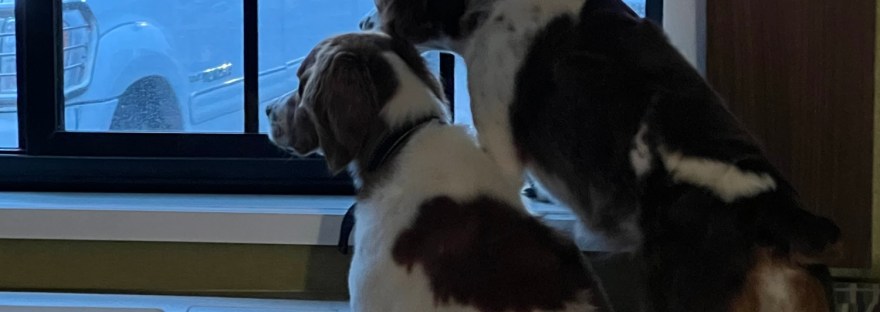
Traveling with dogs should come with a disclaimer: “Warning—may cause extreme chaos, laughter, and moments of pure panic.” Take this morning, for example. Picture it: 5:15 AM, a pitch-black hotel room, and two high-octane pups staring at me like I’m their personal sunrise. Thanks, time zone switch—you really know how to keep a girl on her toes.

I’d barely opened my eyes before both dogs were vibrating with excitement, ready to launch into their own version of the Indy 500 around our 500-square-foot hotel room. I’m tiptoeing around, trying to keep things quiet, but every paw thump and tail wag echoes like we’re rehearsing for Stomp. The suspense? Will we wake up the entire floor before sunrise? Odds are not in my favor.

Once I’m wrangled into my clothes, it’s time for the next challenge: the great outdoors. Except, plot twist, it’s been raining so hard I’m half-expecting to see a pair of giraffes lining up outside. The parking lot has become a small lake, and I’m wading through puddles like a contestant on a reality show—Survivor: Hotel Edition—just to reach the grass.

The dogs, of course, are living their best lives, zooming across the soggy grass with reckless abandon. I’m just trying to keep them from breaking the sound barrier or the property line. Photos are snapped, business is done, and I’m thinking, “Surely, the worst is over.” (Spoiler: it’s not.)

Time to head back in. Remi, my youngest, launches at the door like he’s auditioning for America’s Got Talent. Dakota, the elder stateswoman, tries to beat me inside—only to get her toe caught under the door. Suddenly, the scene turns into a canine opera: Dakota screeching, leashes flying, and me—somewhere between tears and laughter—trying to keep both dogs from reenacting a prison break.

At one point, Remi is locked inside, Dakota’s outside wailing, and I’m juggling leashes, guilt, and the creeping suspicion that I’m about to be evicted. I manage to calm Dakota, get everyone back inside, and—miraculously—no lasting damage. Remi, ever the good boy, is still tethered and waiting patiently. The dogs are loaded into the car, and I finally get a moment to chase down the holy grail: coffee. All this before my first cup. Send help.

Meanwhile, my phone is buzzing with texts from my husband and daughter, worried about my eye issue (which, by the way, is still a thing). I’m grateful for the love, but how do you even begin to explain this dog-fueled circus before breakfast?

And, of course, I still haven’t finished the contract I promised to send last night. I was so exhausted when we checked in at 11 PM that I collapsed face-first onto the bed. Now, I’m staring down a four hour drive to the airport to pick up the hubby and then another two-hour drive, running on empty, praying I can hotspot my laptop and work while my husband drives us home. 

But hey—dogs are fine, I survived, and maybe, just maybe, I’ll get that coffee before the next episode of “Traveling with Dogs: Chaos Unleashed.” 

It’s not even 8 o’clock a.m. yet!

Have you ever had a travel morning like this? Share your funniest (or most suspenseful) pet travel stories below—bonus points if they involve coffee deprivation!

Inspiration

The Heartbeat Between Visits: A Mother’s Grateful Reflection

There’s a quiet blessing in the closeness of grown children—  

Not the kind measured in miles,  

But in the gentle sharing of stories,  

The casual texts, the laughter over dinner,  

And the way they still let me peek into their worlds.

I am grateful for every moment they choose to share—  

For the late-night phone calls,  

The photos of new adventures,  

And the simple, “Love you, Mom,”  

That lands soft as a sigh at the end of a busy day.

Yet, even as I watch them stride into their own lives—  

Capable, clever, carving out their dreams—  

A mother’s worry lingers,  

A silent oversight,  

Hovering over their struggles and challenges,  

Wishing, sometimes, to shoulder the weight

Or to smooth the path ahead,  

Even when I know they must walk it themselves.

There are days when the house feels too still,  

The echo of their laughter fading between visits,  

And I am left with a quiet emptiness—  

A hollow shaped by memories  

Of rebellion and mismatched socks,  

Of tea parties with teddy bears,  

And race tracks built from matchbox cars  

Winding through the living room.

I remember the moments of exasperation—

The slammed doors, the stubborn glares—  

But more often, I recall  

The giggles over spilled tea,  

The sticky hands clutching mine,  

The bedtime stories and whispered secrets  

Shared in the hush of night.

There are regrets, of course—  

Words I wish I’d swallowed,  

Hugs I wish I’d held a little longer,  

But they are outnumbered  

By the moments that brought great joy:  

The pride in their first steps,  

The warmth of their sleepy heads on my shoulder,  

The unexpected “thank yous”  

That melted the hardest days.

Now, as I look back—  

My life feels cherished, blessed, fulfilled.  

I see the tapestry woven from  

Small kindnesses,  

Shared laughter,  

And the simple, enduring love  

That grows, even when we are apart.

My heart is full—  

Grateful for every visit, call, and memory,  

And for the privilege of being  

A mother, always.

Inspiration

Breaking the Mold: A Woman-Owned, Veteran-Led Approach to Home Watch in North Dallas

When you think of home services—especially those involving security, property inspections, and emergency response—most people picture a man showing up with a clipboard. It’s a stereotype that’s been around for decades, and it’s still surprisingly common. But at LoneStar Home Watch, we’re proud to do things differently.

Challenging Expectations in Home Services

As the owner of LoneStar Home Watch, I’ve seen firsthand that the world of property care and home inspection is still very much a “boys’ club.” Many clients—even those who support women in business—are initially surprised when they realize the person inspecting their home is a woman. Some even admit they’d assumed or preferred a man for the job, simply because that’s what they’re used to.

But here’s the thing: professionalism, attention to detail, and trustworthiness aren’t defined by gender. They’re built through training, certification, and a genuine commitment to client care. I am a certified Home Watch professional, and LoneStar Home Watch is only one of two accredited and certified companies in the Dallas metroplex. Our team brings expertise, reliability, and a personal touch to every vidual inspection—qualities that matter far more than outdated expectations.

Why Representation Matters

Having a woman at the helm of a home services business isn’t just about breaking industry norms—it’s about bringing a fresh perspective to client care. Women often bring a unique attention to detail, empathy, and communication style that helps build trust with our clients. I take pride in being approachable, thorough, and always available to answer questions or address concerns.

Our clients benefit from a service that’s not only professional, but also personal. We understand that letting someone into your unoccupied home is a big deal. That’s why we prioritize transparency, digital reporting with photos, and immediate communication—so you always know what’s happening with your property.

Proudly Veteran-Owned

LoneStar Home Watch isn’t just woman-owned—it’s also veteran-owned. Scott, my husband and business partner, is a proud veteran. His experience instilled in us both a sense of duty, discipline, and commitment to service. These values are at the heart of how we operate: with integrity, respect, and a mission-driven approach to protecting your property.

Setting the Standard for Home Watch Services

We know that trust is earned, not given. That’s why we go the extra mile to be A+ Accredited by the BBB, bonded, insured, and certified through NHWA. Our proprietary software ensures every inspection is confidentialy documented, and any issues are reported immediately—with photos and recommended actions.

We’re here to show that the best person for the job isn’t determined by gender, but by dedication, training, and a true passion for service. At LoneStar Home Watch, you get the best of both worlds: the expertise of a certified professional, and the values of a veteran-owned, family-run business.

Ready for peace of mind?
Contact us today for a flat-fee estimate and experience the LoneStar difference—where professionalism, trust, and care come standard, no matter who’s holding the clipboard.

Contact us today: 972-214-4720
Info@lonestrarwatch.com

Inspiration

Too Big for My Britches: Rethinking the Rules We Live By

In the six decades I’ve spent on this earth, I’ve heard the phrase “you’re too big for your britches” more times than I can count. It’s a phrase that, at its core, is meant to keep people—especially women—quiet, compliant, and small. It’s a way of saying, “Don’t draw too much attention. Don’t challenge the status quo. Don’t make anyone uncomfortable.”

The rules that come with it are familiar:  

– Don’t laugh too loud.  

– Don’t cry too hard.  

– Don’t speak up unless spoken to.  

– Forgive, forget, and never hold anyone accountable for how they make you feel.  

– Above all, don’t make waves.

When these unspoken rules didn’t keep me in line, I faced other consequences—distance, abandonment, or even outright hostility. The message was clear: tow the line, or else. Your value is only as much as your willingness to comply.

But here’s the thing: I’m tired of it. And I know I’m not alone.

Why Do We Accept This?

Why do we accept a world where one person’s comfort is valued above another’s authenticity? Why is it considered noble to shrink ourselves so others don’t have to face their own discomfort?

It’s easy to internalize these expectations, to believe that speaking up is the problem, that our feelings are “baggage,” that our voices are too much. But what if the real issue isn’t that we’re “too big for our britches,” but that the britches were never made to fit us in the first place?

The Courage to Challenge

It takes courage to question the rules you’ve been handed. It takes even more to refuse to play by them. I’m learning that honoring my own voice isn’t an act of rebellion—it’s an act of self-respect. And it’s something we owe not just to ourselves, but to those who come after us.

Imagine what would happen if we all stopped bowing to the opinions of those who want us small. What if we held space for each other’s voices, even when they challenge us? What if we measured our worth not by how well we comply, but by how authentically we show up in the world?

An Invitation to Reflect

This isn’t just my story—it’s a challenge to all of us. Next time you find yourself tempted to silence someone, or to shrink yourself for someone else’s comfort, pause and ask:  

– Whose rules am I following?  

– Who benefits from my silence or my compliance?  

– What would it look like to honor my own truth—and allow others to do the same?

Let’s be the generation that outgrows those too-small britches. Let’s encourage each other to take up space, speak up, and live fully—no matter who it makes uncomfortable.

Because real progress doesn’t happen when we all stay quiet. It happens when we dare to be heard. If that “triggers“ some, then so be it. Maybe they just need to look in the mirror. Maybe they’re not self-aware enough to know they’re part of the problem.

jounal entry

America- A Rat Race: Do We Win or Do We Lose?

Walking into Marshall’s, a humble Taylor among the curated chaos. The shades of fabric whisper secrets of their conversions—once coveted, now discarded, their allure fleeting. Feverish hands rummage through the racks, each item a fleeting muse, soon to be forgotten. 

And yet, isn’t this the dance we know so well? Women, like these garments, often appraised for their utility, their sheen, their ability to fit into spaces designed by others. A fever runs through the air—not of admiration, but of judgment. The cold gaze of expectation lingers, as if each thread, each seam, must prove its worth before it’s deemed worthy of a second glance.

We dive into each other’s lives, don’t we? One after another, like garments pulled from the rack, only to be tossed aside when the novelty fades. “Good night,” we say, as if the cold over our shoulders isn’t the chill of being reduced to an emoji—smiling, waving, performing. The items we touch, the lives we pass, will likely find themselves in Goodwill’s embrace before they’ve ever truly been seen.

But isn’t that the status quo? A man’s world, where women are the fabric of the mundane—stitched into roles, hemmed by expectations, and unraveled when deemed too much or too little. Each thread, each glance, each judgment, a reminder: the world appraises, but rarely sees.

Do we need? Should we buy? Is it social? Are we bored? This is something I struggle with releasing hard earned money for things I don’t need. I’m the kind of woman who appreciates a good fishing pole, a running motor in a boat, a good tug on the line, a great muscle car with clean lines, a home that feels welcoming, Dogs by my side, kitties to cuddle, closeness with someone you can truly trust, and maybe a little laughter from a child. There’s my value… And something I feel worth building every single day. What’s yours? 

Inspiration

The Sunburn Catastrophe: A Weekend in the Big Easy

Ah, New Orleans for Easter Sunday. The land of jazz, beignets, and apparently, never-ending blisters. Never ending emergency sirens. Never ending abusively loud noise. Let me walk you through (pun intended) what was supposed to be a relaxing weekend getaway but quickly turned into a comedy of errors—complete with sunburns, stale bread, and the kind of exhaustion that makes you question every life choice.

Thursday Night: The Calm Before the Chaos

We rolled into town around 8 or 9 PM, starving but too tired to care. The hotel bed won the battle over dinner, and we called it a night. Little did I know, this would be the last moment of peace for the next 72 hours.

Friday: Fishing, Friendship, and Fried Knees

The alarm went off at 5:00 AM because apparently, vacations are for sleep deprivation. We headed out for a fishing trip, which was lovely… for the first five minutes. I spent hours bonding with Whitney, Sheldon’s new wife, while getting smacked around by the wind like it owed me money. Meanwhile, the guys lounged under the awning, oblivious to our slow descent into sunburned madness. By the end of the trip, my knees were scorched, my back ached from the boat’s relentless rocking, and all I wanted was a shower.  

But wait, there’s more! Dinner at Mr. B’s was supposed to be the highlight of the day. Instead, it was a symphony of stale bread, disappointing entrees, and an impromptu nine-block hike in heels because Scott apparently moonlights as a tour guide. By the time we got back to the hotel, I was blistered, sunburned, and officially over it.

Saturday: Lettuce, Leather Bars, and Bathroom Emergencies

Saturday started with a lovely visit to see Dave and Debbie—honestly, the highlight of the weekend. But then it was back to the hotel to prepare for another round of walking and dining. Dinner with Wayne and Cindy was fun, but the wedge salad? Let’s just say it was more “lettuce” than “salad.”  

And then came Bourbon Street. Oh, Bourbon Street. Picture this: me, fighting off a fish-induced stomach rebellion, being dragged from bar to bar while dreaming of a bathroom. The Montleone Bar finally gave me the relief I needed (bless their plumbing), and I made my escape back to the hotel, leaving Bourbon Street to the younger, more resilient crowd.

Sunday: Crawfish and Crawling to the Finish Line

Sunday brought a crawfish boil at Sheldon’s. The food was good, the company was better, but the sheer exhaustion of making small talk with strangers left me longing for my couch. By the time we hit the airport, my blisters had blisters, and my knees were still radiating heat like a bad sunlamp experiment.

The Verdict 

Sure, there were some lovely moments—catching up with friends, the crawfish boil, and the occasional laugh—but overall? I think I’ve outgrown the whole “city party” thing. Your dad’s not thrilled with me because he thinks we turned in at 8 PM every night (spoiler: we didn’t), but honestly, I’m okay with that. I came back sunburned, blistered, and with a newfound appreciation for my own bed.

So, New Orleans, thanks for the memories—and the blisters. Next time, I think I’ll just stay home.  

Moral of the Story: 

Sometimes, the best vacations are the ones where you don’t leave your zip code. And always, *always* pack sunscreen.