Journal Entry

The Long Goodbye: Navigating Anticipatory Grief and Chronic Illness

When we think of grief, we often think of it as a destination—a place we arrive at only after a loss has occurred. But for those living through the chronic or terminal illness of a loved one, grief doesn’t wait for a final breath. It settles in early, making itself at home in the quiet corners of the caregiver’s heart.

This experience is known as anticipatory grief, and it is one of the most complex layers of the human experience. At The Soft Armor, we believe in acknowledging these heavy truths so we can better equip ourselves for the journey.

Understanding the “Invisible” Loss

Anticipatory grief is unique because it isn’t just about the fear of the future; it’s about the losses happening in the present. It is the trauma of watching someone’s world shrink. You might be grieving:

• The loss of a role: Moving from partner or child to full-time caregiver.

• The loss of shared dreams: Letting go of travel plans or future milestones.

• The loss of personality: Navigating the way illness can change a person’s temperament or cognitive abilities.

The Trauma of the “Wait”

Living in a state of constant high alert—waiting for the next phone call, the next scan, or the next dip in health—creates a specific kind of physiological trauma. Your nervous system stays “on,” prepared for a crisis that hasn’t fully arrived but feels inevitable.

This sustained stress can lead to “caregiver burnout,” but it’s more than just exhaustion; it’s the soul’s reaction to holding onto someone who is slowly slipping away.

Finding Your “Soft Armor”

How do we protect ourselves while remaining open and present for those who need us?

1. Grant Yourself Permission: Understand that feeling grief right now doesn’t mean you’ve given up hope. It means you are processing the reality of the situation.

2. Acknowledge the Secondary Losses: It is okay to be sad about the “small” things—the lost Sunday morning coffee routines or the quiet house. These are the threads of your daily life being pulled away.

3. Create Pockets of Stillness: When the trauma of illness feels loud, find a ritual that grounds you. Whether it’s a heavy blanket, a specific scent, or five minutes of intentional breathing, find the “armor” that makes you feel safe.

4. Seek Community: Grief is isolating, but you are not alone. Sharing your story with those who understand the “long goodbye” can lighten the emotional load.

Moving Through, Not Over

There is no “getting over” the trauma of sickness and loss. There is only moving through it, one heartbeat at a time. By acknowledging the grief we feel before the loss, we honor the depth of our love and the difficulty of the path we are walking.

Be kind to yourself today. You are doing the hardest work there is.

Inspiration

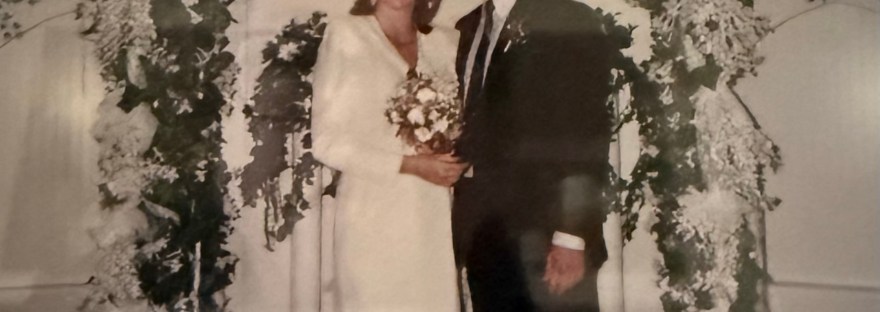
Thirty-Two Years of the Leap

I look at this picture and I can still feel my knees shaking. I remember the weight of the question hanging in the air: would this marriage last for months, for decades, or for a lifetime? Behind my smile, I was a whirlwind of emotion—deeply honored to be Scott’s wife, yet breathless from the whirlwind of it all. “Do you want to get married today?” he had asked just hours earlier.

An elopement at the Rockwall wedding cottage, a quick trip to Dillard’s Travel, and suddenly we were on our way to San Antonio. We didn’t have much then, just a weekend at SeaWorld and each other. In this photo, I was four months pregnant and, if I’m honest, I was scared to death. I was terrified that I wasn’t ready for motherhood—that I wasn’t up to the monumental challenge of raising a child.

And yet, I felt safe.

Wrapped in his arms, I found a sanctuary. Scott brought with him a history of steadiness that I leaned on completely. I trusted that he could navigate us through the unknown; I believed he was capable enough to help rewrite the parts of me that felt broken. I took the leap because of the man he was—a product of a home filled with honor and intentional love. I saw his mother, a woman born to parent, and his father, a jovial and present man whose every move was rooted in kindness. I knew Scott would bring that legacy into our home.

For thirty-two years, he has done exactly that.

Our journey hasn’t been perfect. Anyone who truly knows us can attest that there were seasons of selfishness, moments where we prioritized our own interests over the “us.” But whenever level heads prevailed, the love that sparked that first impulsive “yes” brought us back to center. It kept us learning, growing, and moving in the same direction.

Today, he is my absolute best friend. Our lives are a tapestry of shared ideas, a common moral compass, and a deep, aligned faith. Whether it’s our hobbies or our values, we simply enjoy life more when we are doing it together. Looking back at that shaking girl in the photograph, I wish I could tell her: Don’t worry. You chose well.

Human Interest

When Others Judge – Holding it Together

These past weeks have been a DOOZY for me. While I used to be a bad ass during stressful situations, I have come to learn with experience that loss, real loss, devastating – change – your – life -loss can happen in a moment. Sometimes I think I am one more change away from losing my mind. The older I get the more the fear of loss is real. There’s been a great deal of trauma involved, and that lends itself to more anxiety. Faith. I must have it. God’s got this I tell myself. Naturally, I must learn to believe that.

People often get mad when they’re afraid because anger can be a defense mechanism to cope with the uncomfortable feelings of fear and a sense of vulnerability. If trauma has taught them they cannot trust an unknown outcome, this can be very scary for the people on the other side of that fear. Both fear and anger trigger the “fight-or-flight” response, releasing stress hormones and preparing the body for action. When the nervous system is activated by fear, an individual may unconsciously choose to express this heightened energy as anger, a way to regain a sense of control and protect themselves from a perceived threat.

Anxiety and anger activate the body’s fight-or-flight (stress) response, which triggers the hypothalamic-pituitary-adrenal (HPA) axis to release cortisol, the primary stress hormone. Specifically, the hypothalamus releases corticotropin-releasing hormone (CRH), which signals the pituitary gland to release adrenocorticotropic hormone (ACTH). This, in turn, prompts the adrenal glands to produce and release cortisol into the bloodstream, providing energy to deal with the perceived threat.

I am not sure what the answer is to make sure people around me feel loved. If I lose my shit, something awful has just happened. I am in the thick of cortisol jet streaming throughout my body, and I am one comment away from either losing my mind or walking away because the emotion is too great for me. Horrible but true.

Breathe Beck. Just Breathe.

Human Interest

Navigating Adversity: How Men and Women Approach Life’s Challenges Differently

Adversity is a universal part of life, but how we respond to it can be shaped by everything from upbringing and cultural norms to biology and social support. Let’s explore how men and women typically approach difficult situations, the underlying psychology, and why community—especially for women—is so crucial for resilience.

A Man’s Perspective: Facing Adversity

When confronted with adversity, men often lean on problem-solving and action-oriented strategies. Psychologists call this a “fight-or-flight” response, rooted in both evolutionary biology and social conditioning. Men may feel compelled to “fix” the problem, seek solutions, or sometimes withdraw to process emotions privately.

Typical Male Responses:
– Problem-Solving: Men often try to identify practical solutions and take direct action. This approach is linked to a sense of control and competence.  

– Emotional Suppression: Research shows men are more likely to suppress emotions or avoid discussing feelings, partly due to social norms around masculinity (Mahalik et al., 2003).

– Independence: Men may resist seeking help, valuing self-reliance and autonomy, sometimes to their own detriment (Addis & Mahalik, 2003).

Why This Happens:  
Societal expectations often reward men for stoicism and self-sufficiency. From a young age, boys are taught to “tough it out,” which can make vulnerability feel risky or unmanly. This doesn’t mean men don’t feel deeply; rather, they’re less likely to express distress outwardly or ask for support.

Strengths and Pitfalls:
While this approach can lead to decisive action and resilience, it may also result in isolation, unaddressed stress, or even health issues if emotions are bottled up for too long (Courtenay, 2000).

A Woman’s Perspective: Facing Adversity

Women, by contrast, are more likely to respond to adversity through connection and emotional expression. This is often described as the “tend-and-befriend” response—a term coined by psychologist Shelley Taylor. Women are more likely to seek social support, talk about their feelings, and build networks of care.

Typical Female Responses:
– Seeking Support: Women are more inclined to reach out to friends, family, or support groups when facing difficulties (Taylor et al., 2000).
– Emotional Expression: Women often process adversity by expressing and sharing their emotions, which can promote healing and perspective.
– Collaboration: Women may approach problems collaboratively, brainstorming solutions with others and valuing consensus.

Why This Happens:  
Biologically, the hormone oxytocin—released in response to stress—promotes social bonding and affiliative behaviors, particularly in women (Taylor et al., 2000). Culturally, girls are often encouraged to talk about their feelings and seek support, reinforcing these patterns into adulthood.

Strengths and Pitfalls: 
This approach can foster resilience, reduce feelings of isolation, and provide practical help. However, women may sometimes prioritize others’ needs above their own or struggle if they lack a supportive network.

The Importance of a “Tribe” for Women

The concept of having a “tribe”—a close-knit circle of friends or supporters—is especially vital for women. Research shows that strong social connections are one of the greatest predictors of resilience and well-being, particularly for women navigating adversity (Umberson & Montez, 2010).

Why a Tribe Matters:
– Emotional Support: Sharing struggles with trusted confidantes can reduce stress, increase feelings of belonging, and buffer against depression.
– Practical Help: Friends can offer advice, resources, or hands-on assistance during tough times.
– Identity and Validation: A tribe affirms a woman’s experiences, helping her feel seen and understood.

Science Backs It Up:
Women with strong social networks have better mental and physical health outcomes, recover more quickly from setbacks, and experience lower rates of anxiety and depression (Taylor et al., 2000; Umberson & Montez, 2010).

In Summary

While everyone’s experience is unique, men often default to action and independence, while women gravitate toward connection and collaboration. Both approaches have strengths and limitations, but for women, having a supportive “tribe” is especially powerful for weathering adversity. Recognizing and honoring these differences can help us build more supportive communities—and remind us that, in challenging times, we all benefit from a little help from our friends.

Sources

– Addis, M. E., & Mahalik, J. R. (2003). Men, masculinity, and the contexts of help seeking. *American Psychologist*, 58(1), 5-14.
– Courtenay, W. H. (2000). Constructions of masculinity and their influence on men’s well-being: a theory of gender and health. *Social Science & Medicine*, 50(10), 1385-1401.
– Mahalik, J. R., et al. (2003). Masculinity and men’s health behaviors: The moderating role of gender role conflict. *Psychology of Men & Masculinity*, 4(1), 74.
– Taylor, S. E., et al. (2000). Biobehavioral responses to stress in females: Tend-and-befriend, not fight-or-flight. *Psychological Review*, 107(3), 411-429.
– Umberson, D., & Montez, J. K. (2010). Social relationships and health: A flashpoint for health policy. *Journal of Health and Social Behavior*, 51(1_suppl), S54-S66.

Human Interest

Embracing Change: Aging, Beauty, and the Real Conversation We Need

Cameron Diaz once captured a powerful truth, saying (and I’m paraphrasing here): “Why would I want surgery to change my face? It’s my face—I want to see it every morning.” That sentiment really hits home, especially as we all watch the years leave their mark.

Let’s be honest: aging is inevitable. Our faces change whether we like it or not. Jowls drop, bags form under our eyes, necks ripple, eyelids get heavier, and sometimes our brows settle into that infamous “resting” expression that hardly feels like us. The bright, youthful face we once knew slowly shifts, and when we run into old friends, their surprised looks remind us just how much time has passed—sometimes not as gracefully as we’d hoped.

And it’s not just our faces. Unless you’re hitting the gym religiously post-childbirth, most of us have a midsection that’s grown beyond what we swore we’d allow. Skin issues pop up, health problems creep in, and our hands—once strong and elegant—start to resemble a roadmap. If you’re a boomer, you might be all too familiar with hyperpigmentation taking over once-supple skin.

So when Cameron says to just let it come, maybe she’s onto something. Maybe we’d all be happier if we could accept these changes. But let’s be real—the billion-dollar beauty industry thrives on our insecurities. From Botox to deep-plane facelifts to procedures we never imagined, there’s always a doctor ready to cash in on our desire to turn back the clock.

It’s tough to resist, especially when celebrities—who aren’t always honest about what they’ve had done—tell us to “age naturally” while quietly using every tool in the kit. Then, they turn around and shame others whose cosmetic procedures didn’t go as planned. It’s a maddening cycle, putting so much value on our appearance when, truthfully, what our world needs most is a character overhaul.

Maybe it’s time to shift the conversation. Instead of focusing on fighting every wrinkle, let’s talk about what really matters: kindness, resilience, and the stories that make us who we are. After all, character never goes out of style.

Journal Entry

Why Forced Accountability in Relationships Doesn’t Work: A Clinical Perspective

In healthy relationships, genuine accountability is essential for trust and long-term satisfaction. However, when responsibility is demanded or coerced, the results are often superficial and unsustainable. Research in clinical psychology and relationship science supports the idea that authentic change and remorse must come from within—not from external pressure.

The Pitfalls of Forced Responsibility

When one partner tries to force the other to take responsibility for their actions, it may lead to temporary compliance, but rarely to meaningful change. Studies show that externally motivated apologies or admissions of guilt are often shallow and lack the emotional engagement needed for true growth (Baumeister et al., 1994). In fact, coerced accountability can increase resentment and defensiveness, ultimately harming the relationship further (Finkel et al., 2002).

Authentic Accountability and Empathy

True accountability arises when an individual recognizes the impact of their actions and feels genuine empathy for their partner’s experience. According to Dr. Harriet Lerner, a clinical psychologist and author, “A heartfelt apology is one that doesn’t require prompting, demands, or reminders. It comes from the recognition of the hurt caused and a desire to repair the relationship” (Lerner, 2017).

When someone truly values the relationship, they are internally motivated to make amends. This kind of self-driven accountability is associated with greater relational satisfaction, trust, and long-term stability (Gottman & Silver, 1999).

The Burden of Carrying Guilt for Others

It is not your responsibility to carry the emotional weight of another person’s guilt or to repeatedly prompt them to acknowledge their mistakes. Research indicates that when one partner assumes the role of “reminder” or “enforcer,” it can lead to emotional exhaustion and diminish self-esteem (Fincham & Beach, 2007).

Why Sincere Change Must Be Voluntary

For apologies and behavioral change to have real value, they must be voluntary. Forced or scripted apologies often lack sincerity and do not lead to lasting behavioral improvement (Baumeister et al., 1994). Genuine change requires self-reflection, empathy, and a willingness to repair the harm caused.

What You Deserve in a Relationship

You deserve a partner who takes responsibility because they care—not because you demanded it. Healthy relationships are built on mutual respect, honesty, and voluntary accountability. If someone is unwilling or unable to take ownership of their actions on their own, it may be a sign that they are not ready for the kind of partnership you need and deserve.

Let Actions Speak

Ultimately, allow your partner to show who they truly are. If responsibility isn’t something they choose voluntarily, then their words and actions will likely remain surface-level. As Dr. John Gottman notes, “The willingness to repair and take responsibility is what separates the masters from the disasters of relationships” (Gottman & Silver, 1999).

References:

– Baumeister, R. F., Stillwell, A. M., & Wotman, S. R. (1994). Why would you do that? A psychological analysis of interpersonal forgiveness. *Journal of Personality and Social Psychology, 76*(3), 482-498.

– Finkel, E. J., Rusbult, C. E., Kumashiro, M., & Hannon, P. A. (2002). Dealing with betrayal in close relationships: Does commitment promote forgiveness? *Journal of Personality and Social Psychology, 82*(6), 956-974.

– Gottman, J. M., & Silver, N. (1999). *The Seven Principles for Making Marriage Work*. Crown.

– Lerner, H. (2017). *Why Won’t You Apologize? Healing Big Betrayals and Everyday Hurts*. Touchstone.

– Fincham, F. D., & Beach, S. R. H. (2007). Forgiveness and marital quality: Precursor or consequence in well-established relationships? *Journal of Positive Psychology, 2*(4), 260-268.

Journal Entry

Chaos, Coffee, and Canines: A Morning on the Road

Traveling with dogs should come with a disclaimer: “Warning—may cause extreme chaos, laughter, and moments of pure panic.” Take this morning, for example. Picture it: 5:15 AM, a pitch-black hotel room, and two high-octane pups staring at me like I’m their personal sunrise. Thanks, time zone switch—you really know how to keep a girl on her toes.

I’d barely opened my eyes before both dogs were vibrating with excitement, ready to launch into their own version of the Indy 500 around our 500-square-foot hotel room. I’m tiptoeing around, trying to keep things quiet, but every paw thump and tail wag echoes like we’re rehearsing for Stomp. The suspense? Will we wake up the entire floor before sunrise? Odds are not in my favor.

Once I’m wrangled into my clothes, it’s time for the next challenge: the great outdoors. Except, plot twist, it’s been raining so hard I’m half-expecting to see a pair of giraffes lining up outside. The parking lot has become a small lake, and I’m wading through puddles like a contestant on a reality show—Survivor: Hotel Edition—just to reach the grass.

The dogs, of course, are living their best lives, zooming across the soggy grass with reckless abandon. I’m just trying to keep them from breaking the sound barrier or the property line. Photos are snapped, business is done, and I’m thinking, “Surely, the worst is over.” (Spoiler: it’s not.)

Time to head back in. Remi, my youngest, launches at the door like he’s auditioning for America’s Got Talent. Dakota, the elder stateswoman, tries to beat me inside—only to get her toe caught under the door. Suddenly, the scene turns into a canine opera: Dakota screeching, leashes flying, and me—somewhere between tears and laughter—trying to keep both dogs from reenacting a prison break.

At one point, Remi is locked inside, Dakota’s outside wailing, and I’m juggling leashes, guilt, and the creeping suspicion that I’m about to be evicted. I manage to calm Dakota, get everyone back inside, and—miraculously—no lasting damage. Remi, ever the good boy, is still tethered and waiting patiently. The dogs are loaded into the car, and I finally get a moment to chase down the holy grail: coffee. All this before my first cup. Send help.

Meanwhile, my phone is buzzing with texts from my husband and daughter, worried about my eye issue (which, by the way, is still a thing). I’m grateful for the love, but how do you even begin to explain this dog-fueled circus before breakfast?

And, of course, I still haven’t finished the contract I promised to send last night. I was so exhausted when we checked in at 11 PM that I collapsed face-first onto the bed. Now, I’m staring down a four hour drive to the airport to pick up the hubby and then another two-hour drive, running on empty, praying I can hotspot my laptop and work while my husband drives us home. 

But hey—dogs are fine, I survived, and maybe, just maybe, I’ll get that coffee before the next episode of “Traveling with Dogs: Chaos Unleashed.” 

It’s not even 8 o’clock a.m. yet!

Have you ever had a travel morning like this? Share your funniest (or most suspenseful) pet travel stories below—bonus points if they involve coffee deprivation!

Inspiration

Reflecting Troubling Human Behavior – Analyzing Intent

Lately, I’ve been reflecting on a troubling question: What gives individuals the perceived right to speak with cruelty, to pass judgment, or to wield unkindness as though it were a form of honesty or righteousness?

Is it the culture we’ve created—one that champions “speaking your truth” and “using your voice”—that has inadvertently given rise to a kind of emotional entitlement? Have we mistaken freedom of expression for license to express without restraint, reflection, or responsibility?

We live in an age where personal opinion is treated as sacrosanct, regardless of whether it is informed, empathetic, or constructive. Somewhere along the way, the collective dialogue has shifted. We no longer seem to ask: “Do I understand this person’s experience?” or “Is my voice adding clarity, or merely noise?” Instead, we react—quickly, loudly, and often, harshly—weaponizing our perspectives as a means of control, projection, or defense.

What troubles me most is this: When did we begin expecting others to mirror our values, our emotional responses, our timing, our way of being in the world? And more pointedly—when did deviation from our personal worldview become a reason for disappointment, or even offense?

There is a vast difference between authenticity and aggression, between truth and cruelty. To communicate without empathy, without lived understanding, is not courageous—it’s careless. And perhaps, at its root, it reflects more about the speaker’s unresolved pain than the subject of their critique.

We would do well to remember: Humanity is not a monolith. The expectation that others will move through life exactly as we do is not only unrealistic—it is a fundamental misunderstanding of what it means to be human. And when our differences become reasons for disdain rather than opportunities for curiosity, we all suffer a collective impoverishment of spirit.

Do better! Be better! (Myself included.) #selfawareness

Journal Entry

Rooted and Restless: On the Search for Connection, Intimacy, and a Voice of My Own

For thirty-one years, I have loved someone with an extraordinary depth—a love that has followed him across cities, states, and seasons of life. Each move was a leap of hope, a quiet wish that the next skyline or familiar street might finally fill that elusive gap, bring that missing happiness, or rekindle a spark from the past.

I’ve been happy to do it, truly. The anticipation of new beginnings, the challenge of building a home from boxes and blank walls, the adventure of discovering new parks, coffee shops, and neighbors. But as I sit here, at the edge of yet another “this isn’t quite it” moment, I feel a swirl of emotions: loyalty, fatigue, love, and—if I’m honest—a longing for something more rooted.

We learn the lessons of our lives through others, and our children are no exception. Watching them navigate their own relationships, sometimes stumbling over the same stones we did, I see the faint echo of our own missteps. It’s a sobering realization: we pass along our strengths, but also our brokenness, often without meaning to.

And so here I am, at 62, finally feeling the contentment of roots I’ve worked so hard to cultivate. I crave connection—real, authentic friendships, a sense of belonging, the kind of intimacy that comes from being truly known and seen. I wish I could say I didn’t need it, but I do. I want to live spherically, to have a voice in my own destiny, to be part of a community that doesn’t vanish with every change of address.

I love the outdoors, the beauty of trees and architecture, the pulse of a new city. But why, after all these years, can’t I just visit and return to the life I’ve built, instead of uprooting it again and again? Why must happiness always be somewhere else, just out of reach?

At this age, I’m finally questioning: Will one more move finally deliver the joy that’s been so elusive? Or is it time to claim my own happiness, right here, among the roots I’ve planted and the connections I long to deepen?

I don’t have all the answers. But I do know this: I want a life that’s not just about chasing, but about being—present, connected, and heard. I want to belong, not just to a place, but to myself.

Inspiration

The Heartbeat Between Visits: A Mother’s Grateful Reflection

There’s a quiet blessing in the closeness of grown children—  

Not the kind measured in miles,  

But in the gentle sharing of stories,  

The casual texts, the laughter over dinner,  

And the way they still let me peek into their worlds.

I am grateful for every moment they choose to share—  

For the late-night phone calls,  

The photos of new adventures,  

And the simple, “Love you, Mom,”  

That lands soft as a sigh at the end of a busy day.

Yet, even as I watch them stride into their own lives—  

Capable, clever, carving out their dreams—  

A mother’s worry lingers,  

A silent oversight,  

Hovering over their struggles and challenges,  

Wishing, sometimes, to shoulder the weight

Or to smooth the path ahead,  

Even when I know they must walk it themselves.

There are days when the house feels too still,  

The echo of their laughter fading between visits,  

And I am left with a quiet emptiness—  

A hollow shaped by memories  

Of rebellion and mismatched socks,  

Of tea parties with teddy bears,  

And race tracks built from matchbox cars  

Winding through the living room.

I remember the moments of exasperation—

The slammed doors, the stubborn glares—  

But more often, I recall  

The giggles over spilled tea,  

The sticky hands clutching mine,  

The bedtime stories and whispered secrets  

Shared in the hush of night.

There are regrets, of course—  

Words I wish I’d swallowed,  

Hugs I wish I’d held a little longer,  

But they are outnumbered  

By the moments that brought great joy:  

The pride in their first steps,  

The warmth of their sleepy heads on my shoulder,  

The unexpected “thank yous”  

That melted the hardest days.

Now, as I look back—  

My life feels cherished, blessed, fulfilled.  

I see the tapestry woven from  

Small kindnesses,  

Shared laughter,  

And the simple, enduring love  

That grows, even when we are apart.

My heart is full—  

Grateful for every visit, call, and memory,  

And for the privilege of being  

A mother, always.